
Home / Futsal flooring material
What Is the Best Futsal Flooring Material?
A side-by-side comparison of the five materials most often specified for futsal courts — grip, ball response, drainage, UV stability and what maintenance looks like after a few seasons.
- Manufacturer direct, worldwide shipping
- Free layout drawing with every enquiry
- Sample kit before the bulk order
- No adhesive, no curing time
Why futsal is harder on a floor than most sports
Futsal compresses a lot of mechanical abuse into a small area. Five players per side work in roughly a quarter of a football pitch, so every few seconds someone plants a foot, rotates and accelerates again. A heavy low-bounce ball is struck hard against the floor, and the surface has to return it predictably. That combination — high shear load, repeated point impact and a demand for consistent ball behaviour — is why a material that works perfectly for a school corridor or a gym free-weight area can fail badly on a futsal court.
Three properties matter more than any marketing claim: grip under lateral load, consistency of ball response across the whole court, and what happens to the surface when it gets wet. Everything else, including colour and panel size, is secondary. When you compare futsal flooring material options, start from those three and work outwards to installation, maintenance and the subbase.
The five materials buyers usually compare
Modular polypropylene (PP) panels. Interlocking tiles, typically 340 × 340 mm or 500 × 500 mm, moulded from UV-stabilised virgin PP with a perforated base. They lock along every edge, need no adhesive, drain through the surface and can be lifted and relaid. They suit outdoor courts, leased sites, schoolyards and any facility that has to host more than one sport. This is the material MESKO manufactures.
PVC sports vinyl. A rolled sheet system, usually over a sprung or foam underlay. It gives a very uniform ball bounce and is common in dedicated indoor halls. It needs a dry, sealed, level subfloor, is sensitive to moisture from below, and once glued it is effectively permanent. Not suitable outdoors.
Maple / engineered timber. The traditional competition indoor surface, prized for its tuned shock absorption and ball response. It is the most demanding to install and maintain: humidity control, sanding and refinishing cycles, and strict rules about street shoes. It is also the least forgiving of water.
Acrylic coating on asphalt or concrete. A painted court system built up in layers. It is inexpensive to resurface and popular for outdoor tennis and basketball conversions, but the surface is hard underfoot, develops cracks with the base, and line markings need periodic repainting. It offers no drainage through the surface — water has to run off the slab.
Rubber tiles and poured rubber. Good impact absorption and a soft feel, which is why they dominate playgrounds and weight rooms. For futsal the downside is higher rolling resistance and a slower, less predictable ball, plus a tendency to hold heat and water. Usually a compromise rather than a first choice.
What 100% virgin polypropylene actually changes
The word "virgin" is not a marketing flourish. Recycled PP carries unknown prior heat history and contamination, so its impact strength and UV behaviour vary from batch to batch. On a court, that shows up as panels that chalk, warp at the edges or turn brittle after a couple of hot seasons. Virgin PP with a controlled UV stabiliser package gives repeatable mechanical properties across production runs — important when a school replaces a damaged section three years later and expects the new panels to lock into the old ones.
- Textured anti-slip top face — grip is moulded into the panel, not a coating that wears off.
- Perforated base — rain and wash water pass through instead of pooling on the playing line.
- Four-edge locking — a hard direction change cannot open a seam between panels.
- Colour-panel line markings — moulded in, so there is no paint to re-stripe each season.
- No adhesive, no curing time, no specialist crew — a court can be laid and played on the same day.
MESKO panels are 100% virgin polypropylene, RoHS / REACH compliant and SGS tested. We do not claim sport-governing-body certification; when a project requires a certified competition surface, we say so during the specification stage rather than at handover.
Ball response, grip and player safety
A futsal ball is deliberately under-inflated relative to a football, so it relies on the floor to give it a clean, repeatable rebound. A surface that is too hard produces a skidding, unpredictable bounce; one that is too soft kills the pass. Modular PP sits between the two: the ribbed base flexes slightly under load and returns quickly, which is why the panel thickness and the base geometry matter more than the marketing label on the box.
Grip is a balancing act as well. Maximum friction feels safe in a straight line but can trap a pivoting foot and transfer load to a knee. The goal is controlled, repeatable slip — enough bite for a hard cut, enough give to release. A textured moulded face holds that behaviour when wet far better than a smooth painted coating. If your court is used by children, request a sample and test it with a wet ball and a wet shoe before signing off.
Indoor versus outdoor: UV, drainage and temperature
Indoors, UV and rain disappear from the equation and the decision shifts toward ball feel, acoustics and whether the floor must be portable for events. Outdoors, the two killers are sunlight and standing water. UV-stabilised PP resists chalking; a perforated base removes water vertically so a court is playable shortly after rain rather than after a long drying window. A slight fall in the subbase is still needed to move water away from the site, but the surface itself does not depend on a perfectly dry slab.
Thermal movement is real. A dark-colour court in full sun expands during the day and contracts at night, so an expansion gap at the perimeter and the correct edge trim are part of the specification, not an optional extra. Our subbase and site preparation guide covers the gap and fixing detail.
Maintenance over the whole life of the court
Compare maintenance honestly, not at installation. Timber needs humidity control and periodic refinishing. Acrylic needs crack repair and re-striping. Vinyl needs careful cleaning and is unforgiving of a leaking roof. A modular PP court is washed down, brushed or blown clear of leaves, and a damaged panel can be unclipped and replaced individually rather than resurfacing the whole area. That last point matters most for schools and municipalities with no dedicated grounds budget: a local caretaker can do the work with no contractor call-out.
Ask suppliers three questions before comparing quotes: what happens when one panel breaks, what is written in the UV warranty, and can replacement panels from a later production run lock into the original court. The answers tell you more about the material than a datasheet does.
How to specify material in a tender
- State the material and grade: 100% virgin polypropylene, UV stabilised, with the stabiliser package declared.
- State panel dimensions and thickness, and require the locking system to be described on all four edges.
- Require current test reports (SGS or equivalent) and RoHS / REACH documentation as submitted documents.
- Specify surface texture, drainage geometry and line-marking method — moulded colour panels versus paint.
- Ask for a sample panel with the same production specification as the offered bulk order.
- Define the subbase, fall and perimeter expansion detail separately so every bidder prices the same scope.
Our tender specification guide sets out a comparable bid format, and the buyer checklist lists the documents worth requesting before a purchase order is issued.
Specification summary
| Material | 100% virgin polypropylene (PP), UV stabilised |
| Panel formats | 340 × 340 mm · 500 × 500 mm |
| Thickness | 15 mm / 16 mm options |
| Surface | Moulded multi-sport texture, anti-slip |
| Base | Perforated, self-draining, slight flex |
| Line markings | Moulded colour panels, no repainting |
| Installation | Interlocking, no adhesive, no curing |
| Documents | RoHS / REACH; SGS tested |
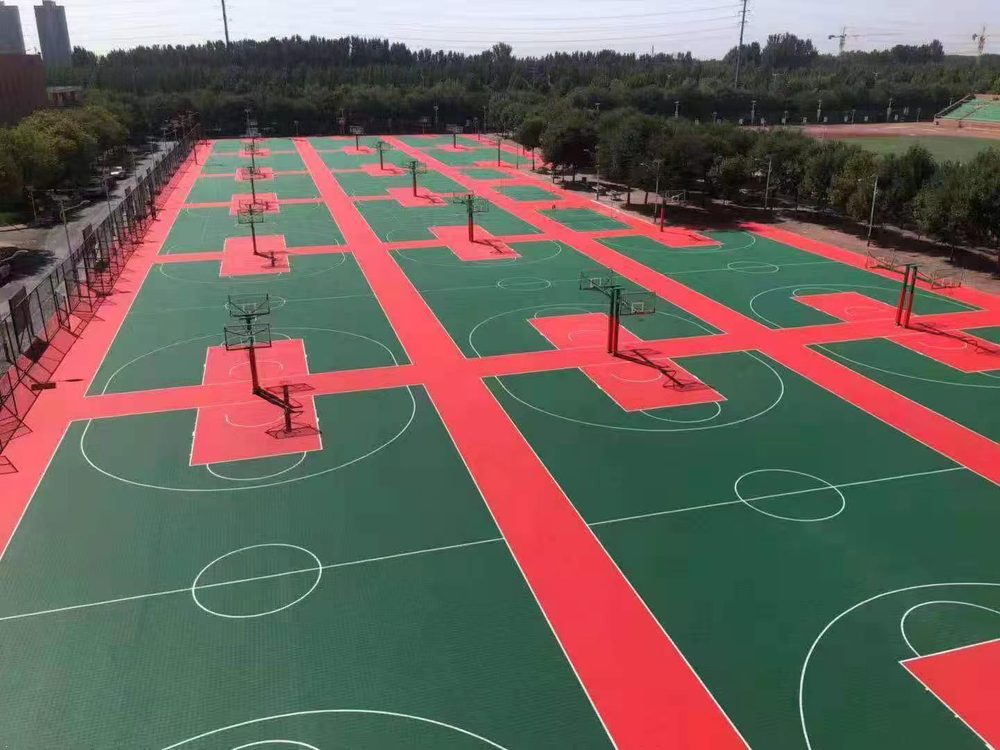
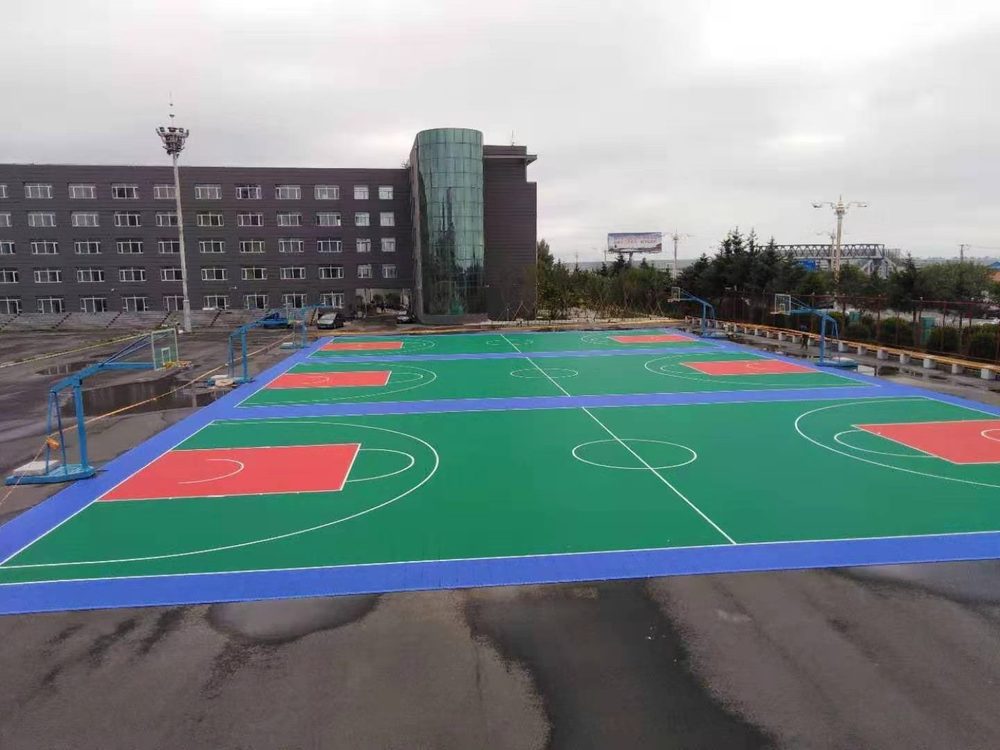
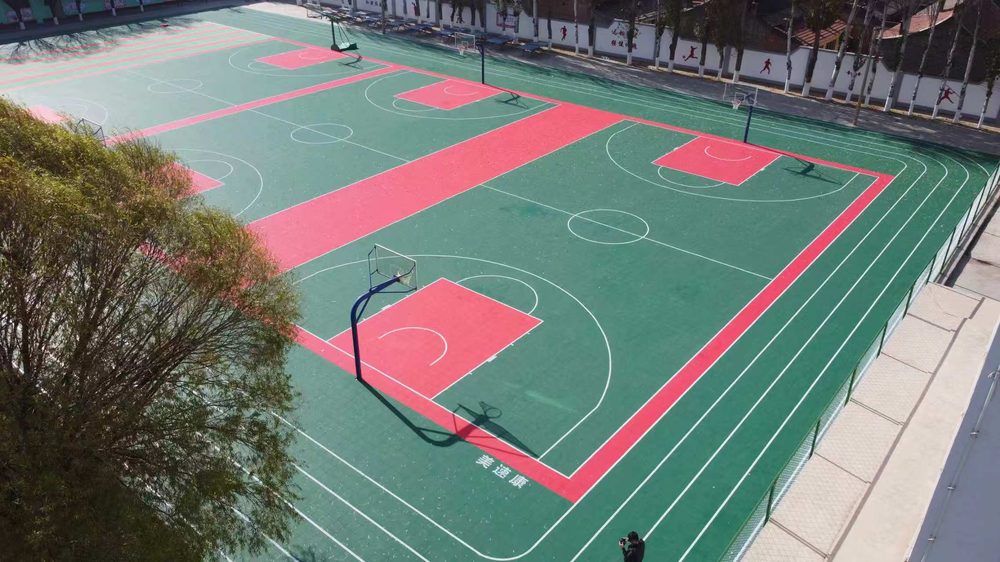
Project photos
Frequently asked questions
What material is used for professional futsal courts?
Indoor competition courts are usually a timber or vinyl sports system over a sprung subfloor. Outdoor and multi-use community courts increasingly use modular polypropylene panels, because they drain, tolerate UV exposure and can be lifted if the site is leased. The right choice depends on whether the court is indoors or out and whether it must serve several sports.
Is polypropylene safe for indoor futsal?
Yes, provided it is a purpose-made sports panel rather than a general-purpose plastic tile. Look for a textured anti-slip surface, a locking edge that cannot open under a change of direction, and documented test reports. MESKO panels are 100% virgin polypropylene, RoHS / REACH compliant and SGS tested.
Does a modular futsal surface feel different from timber?
It does. A modular panel is a semi-rigid surface with a small amount of flex in the base, while a sprung timber floor is tuned for a specific ball bounce and shock absorption. Clubs used to indoor timber should always test a sample panel with their own ball before committing to a full hall.
Can futsal tiles be laid over an existing concrete slab?
Often yes, if the slab is sound, reasonably level and drained. Cracks, standing water and a badly sloped slab will telegraph through the panels, so the base should be repaired first. See our subbase and site preparation guide before ordering.
How long does an outdoor polypropylene futsal surface last?
Service life depends far more on UV exposure, drainage and base quality than on the panel itself. UV-stabilised virgin PP with a perforated base that clears water performs consistently over many seasons; recycled-content panels tend to chalk and become brittle sooner. Ask any supplier for the UV stabiliser specification and a written warranty.
Related pages
Get a free layout drawing and quotation
Send your court size, sport mix, colour requirement and destination port — we reply with the exact panel quantity, a free layout drawing and the full specification.